Tag: Foreign affairs

  • Algeria’s President Bouteflika

    Algeria’s President Bouteflika

    Life, as they say, is in phases and each phase saturated with its own challenges. The Tripoli Program, which served as Algeria’s constitution when it won its war for independence from France in 1962, established the President as the head of state with a Prime Minister assisting in the operation of government.

    Uphill and down dale, Algeria has experienced its own fair share of hiccups from the amendment of the constitution to the worst nightmare of civil war between the military government and Islamic guerrillas. Abdelaziz Bouteflika won his first 5-year term election as the president in 1999 after all other candidates dropped out, and since then, he has won re-election consecutively undisputed and unchallenged. President Bouteflika, who uses a wheelchair and has rarely appeared in public since suffering a stroke in 2013, had provoked mass protests across Algeria over the past few weeks for showing interest in contesting for the fifth time in his announcement a day after he returned home after a two-week stay in a Swiss hospital.

    The reaction on social media was swift, and questions are being asked over the legality of prolonging Mr. Bouteflika’s term in office beyond the constitutional mandate. Algeria had been hit by strikes by teachers and students, as well as shops closing and train services being suspended as thousands took to the streets gaining more momentum every week since the first major demonstration took place on February 16, 2019.

    Algeria was one of the countries in the Northern pole of Africa that was almost untouched when the 2011 Arab spring had its grips on autocrats in the Arab world. The rising demonstrations happen to be the first that the country will experience in this grandeur. What could be said about the Algerians? Force or resilience? The tiredness of the known and a desire of the unknown? A wave of change? 

    Pressure mounted on Mr. Bouteflika to withdraw when more than 1,000 judges said last  Monday they would refuse to oversee the planned general election were he a candidate. Also, the military chief of staff, Lt Gen Gaed Salah, said the military and the people had a united vision of the future indicating that the armed forces were sympathetic to the protests meanwhile, top clerics and unions are not exempted.¹ Although, the 82-year-old president Bouteflika was almost successful in pacifying the protesters by ceding to their demand dropping his ambition of running again after two decades in power but the hope was short-lived following the cancellation of April 18 presidential election, a move that critics fear could allow him to cling to power indefinitely and thereby  giving room to a new phase of protests. 

    Another factor worthy of note is despite people’s anger towards the power structure widely seen as a corrupt and valid fact of millions struggling to make ends meet even with the country’s gas wealth, the protest has been relatively peaceful so far, considering their mass and police was never reported hostile. This is another indication that regardless of uniform or nature of the job, the whole country is on the same pedestal of change which will also come with a price. 


    Reference

    1. BBC world news
  • What is a Nation without Infrastructure?

    What is a Nation without Infrastructure?

    When we are in a state of ignorance, it means we haven’t had the opportunity to be aware or we deliberately disregard important information. Our society is divided into the two aforementioned, with political leaders enlightened about how to better their government but neglect the feasibility, and citizens in complete obscurity of their rights.  While the latter explains the category of people who sometimes don’t expect more than what is within their reach, unable to challenge the status quo. The former is aware that improvement can be done but totally evade the possibility sometimes for their own personal interest.

    Infrastructure and basic amenities are the major problems in Africa especially in Sub-Saharan Africa ranging from electricity and water to roads, railways, functional airports and ports. No economy can function appropriately without infrastructure causing a decline in productivity. Opportunities come with power, for example, a petit trader of frozen fish will be able to run her shop effectively if she is guaranteed of regular power, it means she can use her profit for something else, maybe providing education for her child instead of spending on fuel for the generator. Traders and manufacturers will always need a reliable source of power and water, the population will always require good roads to enable movement and also importers and exporters will require ports to move their goods.

    Leaders in Africa have been exposed to the international standards of living sometimes, by attending meeting and summits in other countries. In some cases, they have spent their study years living in economically developed countries, they have tasted and benefitted from good and perfect infrastructural settings. What then is the cause of this drawbacks in our countries?  It is obvious that infrastructure is important in providing a quality life for people and promoting economic development but it is also a shame that some older people who have never had the opportunity to travel out of their countries might eventually go into their grave without experiencing 24/7 constant power supply. How pathetic! 

    Also, the rise of urbanization has caused a desire to move and relocate to urban centers thereby overpopulating these regions, Some urban centers house more people than its superficial. It is the crossroads where all ethnics meets thereby causing congestion, some of them live in dilapidated buildings with large families squeezed into unfit structures eventually leading to their collapse, especially in the swampy areas.

    The government aptitude has to increase in ensuring the safety and well being of their population by providing the necessary infrastructure. A long term vision, maintenance and continuous progress by the government could be possible solutions. Additionally, the population has to be educated and cultivate good humanly habits. It is effortless to blame the government and leaders but the real change starts with revisiting our mindset as a people.

  • CHINA AS THE NEXT SUPERPOWER

    CHINA AS THE NEXT SUPERPOWER

    Alice Lyman Miller, a China scholar and a former CIA analyst define “A ‘superpower’ as a country that has the capacity to project dominating power and influence anywhere in the world, and sometimes, in more than one region of the globe at a time, and so may plausibly attain the status of global hegemony,” This requires excelling in multiple areas of power projection: economic, military, political and even cultural . In all standards, the United States only wear the cap appropriately since it overtook Great Britain as the world’s dominant country.

    Over the years, there have been several potential superpowers emerging with promising prospects among which the European Union and the BRICS involving Brazil, Russia, India, China, and South Africa are recognized. These countries gain the individual international recognition they deserve, garnished with merited accolades in remaining relevant.

    China has proved itself to be a formidable potential global force, with an outsize influence in shaping the 21st century but whether it overtakes the U.S. is still a mystery though it seems likely. They have been able to transform a poor society by an economic miracle to become arguably the world’s second-largest economy in the world.

    In the last 15 years, China has been involved in a breathtaking and questionable lending, this goes far beyond it’s geographical regions to the depth of Africa. It is important to note that over 100 predominantly low-income countries have gotten Chinese loans in order to finance their infrastructure projects and sometimes expand their producing capacity.

    For instance, Sri Lanka experienced a boom in their economy due to a loan they had gotten from China, the country prospered in all ways and manners but this was short-lived because when the payback time came, the Sri Lanka government realized they have way too much debt. As a result, they ended up renegotiating more deals with the Chinese government which involves a 99-year lease deal handling over control of it’s investments to the Chinese government, one of which is the port of Hambantota.

    Another case, the Kilamba City in Angola is a large housing development which was built by the China International Trust and Investment Corporation and Investment Corporation with the aim of housing up to half a million people but the aftermath of this project was non-profitable as it was too expensive for the middle-class citizen. Nonetheless, the government had already signed a long term deal with their natural resources for the reimbursement of their debts to the  Chinese government.

    With over 10,000 Chinese-owned firms operating in Africa,¹ we must admit that the Chinese are doing quite well in being the next superpower but the motives are quite unclear essentially because, in some of the countries where they build infrastructural projects, they fly in their laborers taking away job opportunities from the population.

    One is forced to ask what are the inherent motives to the Chinese lending, especially to these growing economies? What are the futuristic drawbacks of being indebted to Beijing? Is this the modern day colonialism? What are their diplomatic strategies? 

    China continues to make a mark on the world as they have the largest troop in the United Nations peacekeeping missions, pays more than 10 percent of the UN’s total budget above any country besides the United States. They have shown enormous interest in developing an edge in new technologies such as hypersonic missiles, cyber and artificial intelligence.

    Obviously, China is not folding its arms for an opportunity to be presented to them on a platter of gold and have worked ceaselessly for every achievements and success they have made over the years. Nevertheless, there is more than meets the eyes.

    References:

    1. McKinsey&Company report 
  • Nigeria Election 2019: Igbo, Hausa Tensions?

    Nigeria Election 2019: Igbo, Hausa Tensions?

    There had been agitation across the nation during the preparation for the Nigeria presidential election slated for February 16, 2019, which got postponed to February 23, 2019, by the electoral commission. The incumbent President, Muhammadu Buhari got re-elected and set to be sworn in on June 12, 2019. Even though there were several propositions of rigging by members of the two major parties across several polling units, it cannot be denied that traces of hooliganism and violence were considerably seen in some states which led to the loss of lives and damage of properties.

    It was a notable occurrence that the returning president could not win in any South Eastern State despite his gigantic winning in the North. Regardless, this puzzle is not out of context in any election settings as it has reflected in several election processes in the past. Meanwhile, his party remains the runner up across the Eastern region which means several thousand voted for him even in the East.

    In 1914, Sir Frederick Lugard suggested that the two British protectorates: Southern and Northern will be under one single governor general. A few years later in 1939, the southern protectorate will later be divided into two provinces Western and Eastern. For the country was divided in such a way that the North had slightly more population than the other two regions combined which eventually marked the beginning of three geographical regions that formed along tribal lines, the Hausa and Fulani to the North, Yoruba in the South-West and Igbo to the  South-East to create the present day Nigeria.

    Should it be considered as a  fallacy of hastening generalization to draw out a conclusion that, there is a rigid marginalization coupled with an embittered rivalry between the Northern and Eastern people of the nation following the results of the elections? Understanding that after the colonial period, Nigeria suffered a continuous regional tension, caused by ethnic competitiveness, educational inequality, religious extremists, violent insurgencies and economic imbalance, with the South complaining of northern domination, and the North feared that the southern elite was bent on capturing power. ¹

    This lead to the Nigerian Civil War, also known as the Biafra War from July 1967 to January 1970 which was caused by the attempted secession of the South Eastern province of Nigeria as the self-proclaimed Republic of Biafra. Immediate causes of the war in 1966 included a military coup which resulted in General Aguiyi-Ironsi, an Igbo, assuming power as President, followed by a northerner-led counter-coup, the control of the lucrative oil production in the Niger Delta and the killings of over 80,000 Igbo people in the North of which half of them children. Could it be said that this coupled with the violent conflicts/killings in Southern Kaduna and Benue involving Christians mostly farmers attacked by Hausa-Fulani Muslim herdsmen may have fueled bitterness towards the present government of Muhammadu Buhari?

    Our aim is not to dwell on the past but to reiterate that, “No sacrifice is too much to avert chaos, prevent any further incidence of criminality, protect human lives and spare the lives of the country,”  as stated during the forum of former governors in vanguard news on July 20, 2017.  The sacrifices start with the use of information at our disposal. Planting and building on seeds of contempt and hatred will not in any way help the country. The president has a burden of responsibility on the nation, not on the area that voted him in or his tribe.


    References:

    1. Britannica. com
    2. The roots of Nigeria’s religious and ethnic conflict by  Moses Ochonu
  • The Faults in Africa Education System

    The Faults in Africa Education System

    IMG_1969

    The education system in Africa, contrary to the belief of many, existed a long time possibly taking its origin from Ancient Egypt. The Schools of Holy Scriptures built in Egypt (former Ethiopia and Al-Azhar) were the first form of higher education. These schools became cultural and academic centers attracting people from all over the globe for knowledge and instruction. Meanwhile, the world’s first university was located in Timbuktu, opened in 2600 BC.

    The indigenous knowledge system was based on traditions in which communities effectively taught and learned from themselves through daily life rather than strict education. They used modeling approaches to pass the necessary skills to younger members of the community.

    (more…)

  • The world in the face of Imperialism

    The world in the face of Imperialism

    A crisis is an unexpected event leading to dangerous and unstable results. Crisis in the past has affected countries all over the world, amounting to civil or world wars, dissolution of companies and also economic meltdown. When they affect a country’s constitutional system, they cause changes in all forms and arms of the government.

    (more…)

  • Europe and the Immigration flaws

    The Prime minister of Italy Luigi Di Maio has recently made an outright call out to France and her political system. He accused the country of impoverishing most of the states in Africa. In a rally, Di Maio said “If today, people are leaving Africa, it is because some European countries, with France taking the lead, have never stopped colonizing tens of African states” He talked about colonization which means they have never stopped seeing these African countries as « the Whiteman’s burden »

    IMG_1889

    (more…)

  • Nigeria at a juncture

    The right to information is the core of any good society, government, and economy; this is necessary for the prevention of malpractices, misconduct, abuse of power, violation of rules and illegal activities. In the Western world, the government is held accountable for all deeds in the past, present, and future because they know, that this shows respect and empower their citizens. By informing citizens adequately, they know when and how they should cast their votes, and most importantly gives them a chance to speak out against all sorts of injustices.

    IMG_1854

    (more…)

  • Understanding the French National Protest: Living in the shadow of ressources.


    Citizens often focus more on the shame of losing a struggle, people’s acceptability, cost of leading a campaign and several other limitations which in turn stop them from not only asking for what they want but also for what they are worth, rather than thinking about the value they could bring, the results they could generate for other citizens, their environment and the economy as a whole. 

    Our fears are undoubtedly the biggest barriers to our nation’s success. Civil and political rights (which form the original and main part of international human rights) are a class of rights that protect individuals  freedom from infringement by governments, social organizations, and private individuals, they ensure one’s ability to participate in the civil and political life of the society and state without discrimination or repression. When dissemination of information, transparency and the essence of people are stifled in democracy, heartbreaking tragedies cannot be ruled out in the lives of the populace.

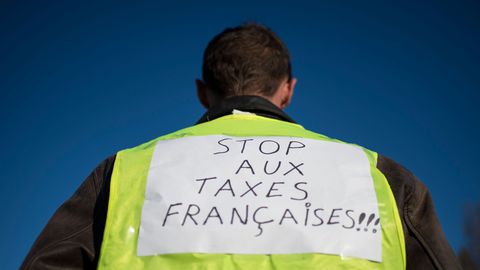
    A yellow vest protester on the 17th of novembre 2018 at Saint-Herblain  afp.com/SEBASTIEN SALOM GOMIS

    (more…)