Tag: Protests

  • Algeria’s President Bouteflika

    Algeria’s President Bouteflika

    Life, as they say, is in phases and each phase saturated with its own challenges. The Tripoli Program, which served as Algeria’s constitution when it won its war for independence from France in 1962, established the President as the head of state with a Prime Minister assisting in the operation of government.

    Uphill and down dale, Algeria has experienced its own fair share of hiccups from the amendment of the constitution to the worst nightmare of civil war between the military government and Islamic guerrillas. Abdelaziz Bouteflika won his first 5-year term election as the president in 1999 after all other candidates dropped out, and since then, he has won re-election consecutively undisputed and unchallenged. President Bouteflika, who uses a wheelchair and has rarely appeared in public since suffering a stroke in 2013, had provoked mass protests across Algeria over the past few weeks for showing interest in contesting for the fifth time in his announcement a day after he returned home after a two-week stay in a Swiss hospital.

    The reaction on social media was swift, and questions are being asked over the legality of prolonging Mr. Bouteflika’s term in office beyond the constitutional mandate. Algeria had been hit by strikes by teachers and students, as well as shops closing and train services being suspended as thousands took to the streets gaining more momentum every week since the first major demonstration took place on February 16, 2019.

    Algeria was one of the countries in the Northern pole of Africa that was almost untouched when the 2011 Arab spring had its grips on autocrats in the Arab world. The rising demonstrations happen to be the first that the country will experience in this grandeur. What could be said about the Algerians? Force or resilience? The tiredness of the known and a desire of the unknown? A wave of change? 

    Pressure mounted on Mr. Bouteflika to withdraw when more than 1,000 judges said last  Monday they would refuse to oversee the planned general election were he a candidate. Also, the military chief of staff, Lt Gen Gaed Salah, said the military and the people had a united vision of the future indicating that the armed forces were sympathetic to the protests meanwhile, top clerics and unions are not exempted.¹ Although, the 82-year-old president Bouteflika was almost successful in pacifying the protesters by ceding to their demand dropping his ambition of running again after two decades in power but the hope was short-lived following the cancellation of April 18 presidential election, a move that critics fear could allow him to cling to power indefinitely and thereby  giving room to a new phase of protests. 

    Another factor worthy of note is despite people’s anger towards the power structure widely seen as a corrupt and valid fact of millions struggling to make ends meet even with the country’s gas wealth, the protest has been relatively peaceful so far, considering their mass and police was never reported hostile. This is another indication that regardless of uniform or nature of the job, the whole country is on the same pedestal of change which will also come with a price. 


    Reference

    1. BBC world news
  • Nigeria Election 2019: Igbo, Hausa Tensions?

    Nigeria Election 2019: Igbo, Hausa Tensions?

    There had been agitation across the nation during the preparation for the Nigeria presidential election slated for February 16, 2019, which got postponed to February 23, 2019, by the electoral commission. The incumbent President, Muhammadu Buhari got re-elected and set to be sworn in on June 12, 2019. Even though there were several propositions of rigging by members of the two major parties across several polling units, it cannot be denied that traces of hooliganism and violence were considerably seen in some states which led to the loss of lives and damage of properties.

    It was a notable occurrence that the returning president could not win in any South Eastern State despite his gigantic winning in the North. Regardless, this puzzle is not out of context in any election settings as it has reflected in several election processes in the past. Meanwhile, his party remains the runner up across the Eastern region which means several thousand voted for him even in the East.

    In 1914, Sir Frederick Lugard suggested that the two British protectorates: Southern and Northern will be under one single governor general. A few years later in 1939, the southern protectorate will later be divided into two provinces Western and Eastern. For the country was divided in such a way that the North had slightly more population than the other two regions combined which eventually marked the beginning of three geographical regions that formed along tribal lines, the Hausa and Fulani to the North, Yoruba in the South-West and Igbo to the  South-East to create the present day Nigeria.

    Should it be considered as a  fallacy of hastening generalization to draw out a conclusion that, there is a rigid marginalization coupled with an embittered rivalry between the Northern and Eastern people of the nation following the results of the elections? Understanding that after the colonial period, Nigeria suffered a continuous regional tension, caused by ethnic competitiveness, educational inequality, religious extremists, violent insurgencies and economic imbalance, with the South complaining of northern domination, and the North feared that the southern elite was bent on capturing power. ¹

    This lead to the Nigerian Civil War, also known as the Biafra War from July 1967 to January 1970 which was caused by the attempted secession of the South Eastern province of Nigeria as the self-proclaimed Republic of Biafra. Immediate causes of the war in 1966 included a military coup which resulted in General Aguiyi-Ironsi, an Igbo, assuming power as President, followed by a northerner-led counter-coup, the control of the lucrative oil production in the Niger Delta and the killings of over 80,000 Igbo people in the North of which half of them children. Could it be said that this coupled with the violent conflicts/killings in Southern Kaduna and Benue involving Christians mostly farmers attacked by Hausa-Fulani Muslim herdsmen may have fueled bitterness towards the present government of Muhammadu Buhari?

    Our aim is not to dwell on the past but to reiterate that, “No sacrifice is too much to avert chaos, prevent any further incidence of criminality, protect human lives and spare the lives of the country,”  as stated during the forum of former governors in vanguard news on July 20, 2017.  The sacrifices start with the use of information at our disposal. Planting and building on seeds of contempt and hatred will not in any way help the country. The president has a burden of responsibility on the nation, not on the area that voted him in or his tribe.


    References:

    1. Britannica. com
    2. The roots of Nigeria’s religious and ethnic conflict by  Moses Ochonu
  • Nigeria at a juncture

    The right to information is the core of any good society, government, and economy; this is necessary for the prevention of malpractices, misconduct, abuse of power, violation of rules and illegal activities. In the Western world, the government is held accountable for all deeds in the past, present, and future because they know, that this shows respect and empower their citizens. By informing citizens adequately, they know when and how they should cast their votes, and most importantly gives them a chance to speak out against all sorts of injustices.

    IMG_1854

    (more…)

  • Understanding the French National Protest: Living in the shadow of ressources.


    Citizens often focus more on the shame of losing a struggle, people’s acceptability, cost of leading a campaign and several other limitations which in turn stop them from not only asking for what they want but also for what they are worth, rather than thinking about the value they could bring, the results they could generate for other citizens, their environment and the economy as a whole. 

    Our fears are undoubtedly the biggest barriers to our nation’s success. Civil and political rights (which form the original and main part of international human rights) are a class of rights that protect individuals  freedom from infringement by governments, social organizations, and private individuals, they ensure one’s ability to participate in the civil and political life of the society and state without discrimination or repression. When dissemination of information, transparency and the essence of people are stifled in democracy, heartbreaking tragedies cannot be ruled out in the lives of the populace.

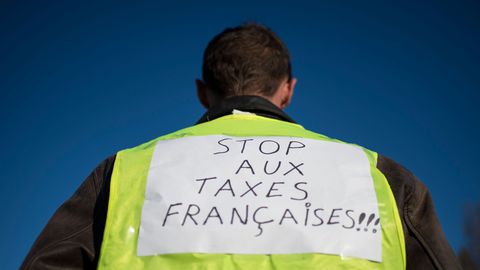
    A yellow vest protester on the 17th of novembre 2018 at Saint-Herblain  afp.com/SEBASTIEN SALOM GOMIS

    (more…)