Tag: Articles

Tags posts about Articles.

  • HUMAN DEVELOPMENT IN AFRICA

    HUMAN DEVELOPMENT IN AFRICA

    Human development which is always confused with economic growth empowers people to participate in the improvement of their own well-being, live a life of absolute freedom on their decisions, actions, and ways of life.

    It portrays how economic policy has influenced their quality of life and helps in grouping countries as developed, developing, or underdeveloped. The core of human development is the concept of capabilities which has the basics as good health, access to knowledge, and a decent material standard of living. These “capabilities” are the determinant of living a fulfilled life or not, realizing human potential and can either be expanded or constrained by an individual or constituted effort and conditions of our society.

    (more…)

  • The Paradox of a Praying Nation

    The Paradox of a Praying Nation

    One will assume that religious chastity equals good morals, the twist in religion and religious acts in glorifying corruption is alarming. Where prayers exist, corruption should not cohabit because these two are conflicting puzzles annihilating our society on a daily basis. Prayers are often said out of ignorance and sometimes used as tools of amassing wealth and keeping the populace in continuous poverty. 

    (more…)

  • Let our trees live!

    Let our trees live!

    Trees are one of the most important parts of the forest ecology, they are known to be part of the world’s most efficient repository of carbon monoxide.  The greenhouse gas known for the increase in the planet’s temperature and the source of climate change. When a tree is fell, it’s canopy which blocks the sun rays during the day and retains heat at night can no longer serve its purpose.

    (more…)

  • Loss and Pain

    Loss and Pain

    The anguish of loss can be devastating, be it in cases of calamities, bereavement, disappearance or even getting laid off a job. Loss is inevitable, we lose people and when that happens, the agony is felt because this is a journey of no return where promises are left unkept, dreams are left unachieved and memories linger on the side of those  behind. However, when it happens intentionally, it is even more sorrowful.

    Yesterday she said “Mary just died to me “it felt awkward, I didn’t understand what she meant and I asked her. She said “in my world, Mary just died. I no longer consider her a friend, neither do I want to have anything to do with her.”  I was dazed, I remembered that just last week, she and Mary were best friends, jolly, loving and adorable.

    (more…)

  • Get out of your nest and fly

    Get out of your nest and fly

    When she turned 18, it was in a foreign country far away from home. Her roommate,  Jane(confidentiality clause) was the first person to wish her a happy birthday but followed it with this sentence  « It is time to come out of your shell and start living »

    As a child, she was quite tall and had an affirmative stature. She was bigger and taller than all her playmates, She didn’t like that at all. She didn’t feel pretty and believed the petite girls were the most beautiful and everyone admired them. She was a shy kid and always wanted to hide. You know those type of students who will never talk in class or give their opinion, she wanted to disappear and be alone.

    Nevertheless, as she grew up  she grew out of her nest and learnt to fly,  but she soon realized that almost everyone she knew lived with a particular insecurity about themselves

    « If only my butt can be smaller,   I have a big nose, My boobs are too big, I am too fat, If only I could gain 10 kilos and have more flesh then my life will be better, I am too dark and people laugh at me, I turn red when I speak and I always hate myself,  I have sweaty palms and people are scared of coming close to me, I am short so I have to dress to impress in order to get noticed. »

    The truth is that we let people say so many kinds of stuff to us because they are things we also believed to be true about ourselves. For her, she kept them in her heart, she remembered them on her bed, her pillow was always soaked in her tears, her heart was often broken at the end of each day, yes she let it and you too, you are letting them.

    But then, She had to focus on something else, it was her studies, it was the perfect rebound of all negativity. She was reading and all she wanted was succeed, but this didn’t take the lack of self-confidence away.

    Her miracle started when she began to know herself, she started writing all she thought to God and this changed her life. It made her have a good relationship with herself, her pains, her thoughts, her strengths, her weakness was inscribed in that book where she wrote to the Almighty. She even wrote about those that hurt her. She gradually learnt to appreciate her person and her morphology, to forgive those that called her names and most importantly she gained her inner strength and confidence. She keened on to the word that she is wonderfully and carefully made.

    In life, we cannot all be the same, we are unique and all have our areas of greater capabilities. You are a masterpiece when you believe in yourself, others will see it and respect you. Confidence is not just an aspiration, it should be a way of life. At some point, we all have to get out of our shell and fly because we spend the most time with ourselves and therefore we cannot run away, decide to build yourself up.


    https://www.youtube.com/watch?v=NkvGTht2xTY

  • What is a Nation without Infrastructure?

    What is a Nation without Infrastructure?

    When we are in a state of ignorance, it means we haven’t had the opportunity to be aware or we deliberately disregard important information. Our society is divided into the two aforementioned, with political leaders enlightened about how to better their government but neglect the feasibility, and citizens in complete obscurity of their rights.  While the latter explains the category of people who sometimes don’t expect more than what is within their reach, unable to challenge the status quo. The former is aware that improvement can be done but totally evade the possibility sometimes for their own personal interest.

    Infrastructure and basic amenities are the major problems in Africa especially in Sub-Saharan Africa ranging from electricity and water to roads, railways, functional airports and ports. No economy can function appropriately without infrastructure causing a decline in productivity. Opportunities come with power, for example, a petit trader of frozen fish will be able to run her shop effectively if she is guaranteed of regular power, it means she can use her profit for something else, maybe providing education for her child instead of spending on fuel for the generator. Traders and manufacturers will always need a reliable source of power and water, the population will always require good roads to enable movement and also importers and exporters will require ports to move their goods.

    Leaders in Africa have been exposed to the international standards of living sometimes, by attending meeting and summits in other countries. In some cases, they have spent their study years living in economically developed countries, they have tasted and benefitted from good and perfect infrastructural settings. What then is the cause of this drawbacks in our countries?  It is obvious that infrastructure is important in providing a quality life for people and promoting economic development but it is also a shame that some older people who have never had the opportunity to travel out of their countries might eventually go into their grave without experiencing 24/7 constant power supply. How pathetic! 

    Also, the rise of urbanization has caused a desire to move and relocate to urban centers thereby overpopulating these regions, Some urban centers house more people than its superficial. It is the crossroads where all ethnics meets thereby causing congestion, some of them live in dilapidated buildings with large families squeezed into unfit structures eventually leading to their collapse, especially in the swampy areas.

    The government aptitude has to increase in ensuring the safety and well being of their population by providing the necessary infrastructure. A long term vision, maintenance and continuous progress by the government could be possible solutions. Additionally, the population has to be educated and cultivate good humanly habits. It is effortless to blame the government and leaders but the real change starts with revisiting our mindset as a people.

  • A pathetic trend in our society: Suicide

    A pathetic trend in our society: Suicide

    Mornings are bright, reassuring and often filled with hope, it is another chance to start over again in a better way in the hurdles of life. In the same vein, nights also has her glamorous beauty, closure and rest though dark but unique. Seas dry, just like trees, animals, and birds die obeying the cycle of life. Humans are no exception even though, a bit more dramatic yet the inevitable cannot but happen eventually. Death is agreeably a spectacular design in all living creations which put an end to existence, but no one in their right mind wishes to die irrespective of how long they have lived. This becomes a puzzle, raise questions and leave others in awe when the cause of death was perpetrated by self. It is termed SUICIDE.

    Researches by WHO shows that Close to 800,000 people die due to suicide every year that is, one person every 40 seconds. Which further reveal that for each adult who died by suicide there may have been more than 20 others attempting suicide.¹ The act of committing suicide used to be very rare in Africa communities and even termed “western madness” in some part of Africa showing their firm belief in the common phrase “when there is life, there is hope”. Nigeria now ranks the 30th most suicide-prone country out of 183 nations in the world with 15.1% suicides per 100,000 people annually.²

    One cannot but wonder what prompted the underrated abuse of will and freedom motivating people regardless of age group resorting to the inhumane plague of the mind. The inquisition has over time shows depression, mental disorders, financial difficulty, marital problems, academic challenges, rejection, and several others things deem to be mundane as causative reasons for such drastic decision and an easy way out of all these worries. An average Nigerian has one worry or the other especially, as surviving in the country has continued to prove tougher leading to a rampant rate of suicide cases lately.

    Though other causes like terminal diseases, absence of working national security system, lack of unemployment benefits, lack of good infrastructure and unfavorable economy can lead people to commit suicide, it cannot be overemphasized that 90 percent of people who commit suicide suffer from depression or mental illness with bipolar and schizophrenic disorder inclusive. Most of the major causes of death which include sickness, poverty, and malnutrition happen to also be, some of the causes of depression. Indeed, tackling depression in our society could be the first giant step to eradicate suicide.

    Even though, it is a crime to attempt suicide, prosecution of the act appears to be rare probably due to lack of correctional facility to help them or measures to reduce the reoccurrence of such act. Unlike diseases and sicknesses that can be prevented and treated when prevention fails, nothing brings succor to a dejected soul except appropriate counseling. Family and friends often fail to understand the symptoms of suicide not until after the harm has been done. The burden suicide does extend beyond the deceased as it psychologically affects people left behind, filling them with guilt and contempt wondering if there is something they could have done right leaving their heart bruised. It is important that we begin to take every abnormal behavior, violent remarks and careless statements of frustration serious and observe closely.

    There is a need for government, NGOs, churches, and other institutions to create awareness to sensitize the populace closing the gap in the treatment of depression and establish counseling centers where people could visit to seek succor as prevention is the only viable approach to curb the habit of committing suicide. As much as we hate to be caught up in poverty, sickness, disappointment, rejection, et al… we should never forget they are part of life which has been from the time immemorial and will be till the end of time. It is our duty to overcome the challenges! 

    If you need help? 

    Nigeria, Togo, Ghana, USA, South Africa, Kenya, Cameroun

    Europe Union: Call 112

    If you need to talk to someone who respects your confidentiality send an email or connect with us on our official pages on the top bar above.

    References:

    1. World Health Organisation Report
    2. Africa.com
  • CHINA AS THE NEXT SUPERPOWER

    CHINA AS THE NEXT SUPERPOWER

    Alice Lyman Miller, a China scholar and a former CIA analyst define “A ‘superpower’ as a country that has the capacity to project dominating power and influence anywhere in the world, and sometimes, in more than one region of the globe at a time, and so may plausibly attain the status of global hegemony,” This requires excelling in multiple areas of power projection: economic, military, political and even cultural . In all standards, the United States only wear the cap appropriately since it overtook Great Britain as the world’s dominant country.

    Over the years, there have been several potential superpowers emerging with promising prospects among which the European Union and the BRICS involving Brazil, Russia, India, China, and South Africa are recognized. These countries gain the individual international recognition they deserve, garnished with merited accolades in remaining relevant.

    China has proved itself to be a formidable potential global force, with an outsize influence in shaping the 21st century but whether it overtakes the U.S. is still a mystery though it seems likely. They have been able to transform a poor society by an economic miracle to become arguably the world’s second-largest economy in the world.

    In the last 15 years, China has been involved in a breathtaking and questionable lending, this goes far beyond it’s geographical regions to the depth of Africa. It is important to note that over 100 predominantly low-income countries have gotten Chinese loans in order to finance their infrastructure projects and sometimes expand their producing capacity.

    For instance, Sri Lanka experienced a boom in their economy due to a loan they had gotten from China, the country prospered in all ways and manners but this was short-lived because when the payback time came, the Sri Lanka government realized they have way too much debt. As a result, they ended up renegotiating more deals with the Chinese government which involves a 99-year lease deal handling over control of it’s investments to the Chinese government, one of which is the port of Hambantota.

    Another case, the Kilamba City in Angola is a large housing development which was built by the China International Trust and Investment Corporation and Investment Corporation with the aim of housing up to half a million people but the aftermath of this project was non-profitable as it was too expensive for the middle-class citizen. Nonetheless, the government had already signed a long term deal with their natural resources for the reimbursement of their debts to the  Chinese government.

    With over 10,000 Chinese-owned firms operating in Africa,¹ we must admit that the Chinese are doing quite well in being the next superpower but the motives are quite unclear essentially because, in some of the countries where they build infrastructural projects, they fly in their laborers taking away job opportunities from the population.

    One is forced to ask what are the inherent motives to the Chinese lending, especially to these growing economies? What are the futuristic drawbacks of being indebted to Beijing? Is this the modern day colonialism? What are their diplomatic strategies? 

    China continues to make a mark on the world as they have the largest troop in the United Nations peacekeeping missions, pays more than 10 percent of the UN’s total budget above any country besides the United States. They have shown enormous interest in developing an edge in new technologies such as hypersonic missiles, cyber and artificial intelligence.

    Obviously, China is not folding its arms for an opportunity to be presented to them on a platter of gold and have worked ceaselessly for every achievements and success they have made over the years. Nevertheless, there is more than meets the eyes.

    References:

    1. McKinsey&Company report 
  • Child Maltreatment and Sexual Abuse

    Child Maltreatment and Sexual Abuse

    John is a smart, brown-eyed boy, slightly tall and dark thick hair like the mist of Indian embroidered in beauty somewhat as the Greek god Adonis whom Aphrodite couldn’t get over. As a child, he was that type of baby everyone wanted to kiss and hold in their hands. He is now 11 years and still radiates the beauty and glow of a baby except for the way he paraded on foot. There is an unusual limping related to his style, at first you will believe it is a voguish manner associated to prepubescent children of his era but a deeper look, you will be forced to question his faltering walk.

    (more…)

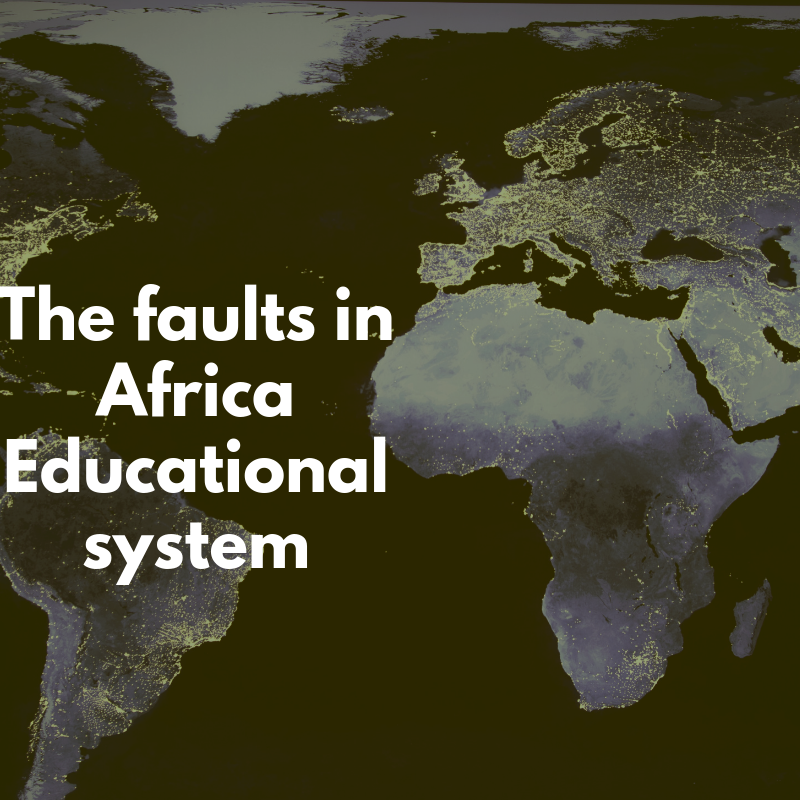
  • The Faults in Africa Education System

    The Faults in Africa Education System

    IMG_1969

    The education system in Africa, contrary to the belief of many, existed a long time possibly taking its origin from Ancient Egypt. The Schools of Holy Scriptures built in Egypt (former Ethiopia and Al-Azhar) were the first form of higher education. These schools became cultural and academic centers attracting people from all over the globe for knowledge and instruction. Meanwhile, the world’s first university was located in Timbuktu, opened in 2600 BC.

    The indigenous knowledge system was based on traditions in which communities effectively taught and learned from themselves through daily life rather than strict education. They used modeling approaches to pass the necessary skills to younger members of the community.

    (more…)